Protopic
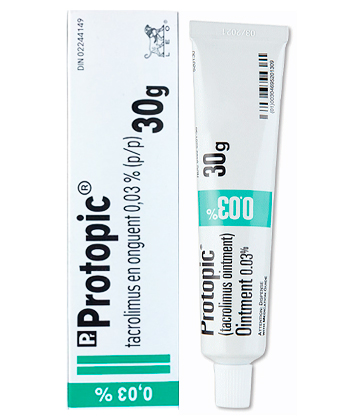
Protopic
- Protopic is prescription-only (Rx) in virtually all markets (USA, EU, Japan, etc.), but availability varies by country and some brick-and-mortar pharmacies or online sellers may supply tacrolimus ointment without requiring a prescription; regulations and legality depend on local law—use caution and follow local medical advice.
- Protopic (tacrolimus) is used to treat moderate-to-severe atopic dermatitis (eczema); it is a topical calcineurin inhibitor that reduces T‑cell activation and inflammatory cytokine release in the skin.
- Usual dosing: apply a thin layer twice daily to affected areas; children 2–15 years: 0.03% ointment; adolescents ≥16 years and adults: 0.03% or 0.1% ointment as indicated; for maintenance some regimens use once or twice weekly re‑application to previous lesions.
- Form of administration: topical ointment (0.03% and 0.1% concentrations), supplied in tubes (commonly 30 g, 60 g sizes).
- Onset time: some symptomatic relief may occur within days, but clearing of flares typically occurs within 1–3 weeks of twice-daily use.
- Duration of action: continued twice-daily application is used until lesions clear; maintenance dosing (once or twice weekly) can reduce relapses; long-term use has been evaluated for up to several years in selected studies.
- Alcohol warning: avoid applying alcohol-containing products to treated skin and be aware some patients report flushing or sensitivity with alcohol intake after application; general ingestion of alcohol is not specifically contraindicated, but avoid excessive sun/UV exposure on treated areas.
- The most common side effect is transient local irritation—burning or stinging at the application site—sometimes accompanied by itching, redness, or tingling; less common effects include folliculitis or viral skin infections.
- Would you like to try protopic without a prescription?
Key Findings From Recent Trials
Basic Protopic Information
- INN (International Nonproprietary Name): Tacrolimus.
- Brand Names Available In United States: Protopic (available as ointment 0.03% and 0.1%).
- ATC Code: D11AH01.
- Forms & Dosages: Ointment 0.03% (for children ≥2 years and adults) and ointment 0.1% (for adults and adolescents ≥16 years), commonly sold in tubes (for example 30g and 60g).
- Manufacturers In United States: Original manufacturer Astellas Pharma with multiple global generic manufacturers including Sandoz, Glenmark, Intas, Cipla, and Emcure supplying generics in various markets.
- Registration Status In United States: Rx only; FDA-approved for moderate-to-severe atopic dermatitis in adults and children ≥2 years who have failed standard therapies.
- OTC / Rx Classification: Prescription only (Rx) in virtually all markets.
What did the latest trials actually show about Protopic and tacrolimus ointment?
Recent clinical research from 2022 to 2026 reinforced tacrolimus ointment’s role in controlling flares and enabling proactive maintenance for atopic dermatitis.
Treatments applied twice daily during flares commonly cleared lesions within one to three weeks, consistent with established studies.
Maintenance regimens using once- or twice-weekly application to previously affected sites lowered relapse rates in pooled cohorts and extension studies.
Selected long-term cohorts reported safety data up to four years supporting chronic intermittent use for some patients.
Regulatory dossiers and pooled analyses found safety signals consistent with earlier data, without new systemic safety concerns in topical use cohorts.
The most frequent safety observations across trials were transient local burning, stinging, and mild erythema at the application site.
Systemic absorption remained minimal in studies of dermal application, and no routine hepatic or renal dose adjustments were required for topical therapy.
Evidence gaps noted by authors include few randomized head-to-head trials against newer non-steroidal agents and limited pregnancy and lactation datasets.
Guidelines continue to position tacrolimus as a steroid-sparing option especially for sensitive areas such as the face and eyelids.
Product monographs confirm approvals and the Rx-only status, with labeled strengths 0.03% for children ≥2 years and 0.1% for adults and adolescents ≥16 years.
Major 2022–2026 Studies
Which studies shaped the recent conclusions about tacrolimus?
Recent trend analyses and long-term extension studies between 2022 and 2026 pooled data from maintenance and flare-treatment cohorts of tacrolimus ointment.
These studies emphasized proactive, intermittent strategies to reduce relapse in chronic atopic dermatitis.
Many trials compared twice-daily flare control followed by once- or twice-weekly maintenance to standard reactive treatment plans.
Longitudinal data in selected cohorts extended safety observation windows up to four years for intermittent topical use.
Head-to-head randomised comparisons with non-steroidal agents were sparse, a limitation noted across review articles.
Overall, major trials re-affirmed tacrolimus ointment’s efficacy and steroid-sparing utility in sensitive skin areas.
Main Outcomes
What clinical outcomes clinicians and patients can expect?
Twice-daily application during flares commonly produced lesion clearance in one to three weeks for many patients.
Proactive maintenance applied once or twice weekly to previous lesions consistently reduced recurrence compared with no maintenance in pooled analyses.
Quality-of-life measures improved when tacrolimus reduced the need for prolonged topical steroid use on delicate areas.
Clinical outcomes aligned with product labeling and guideline recommendations for steroid-sparing strategies.
Safety Observations
What safety patterns emerged in recent work?
Local transient reactions—burning, stinging, and mild erythema—were the most reported adverse effects and often resolved with continued use.
Less common events included folliculitis, local viral reactivation (for example herpes simplex), and acneiform eruptions.
Systemic absorption was minimal in intact skin cohorts, and trials reported no routine need for hepatic or renal monitoring for topical use.
Studies called for caution in immunocompromised patients and flagged limited data for pregnancy and lactation as areas needing more evidence.
Clinical Mechanism Of Action
Layman’S Explanation
How does tacrolimus ointment calm eczema in plain language?
Tacrolimus ointment reduces skin inflammation by blocking key immune cells that drive eczema flares.
It is a non‑steroidal topical option that avoids the skin‑thinning risks associated with topical corticosteroids.
This makes it especially useful for delicate skin such as the face, eyelids, and skin folds.
Scientific Breakdown
What is the pharmacology behind tacrolimus topical therapy?
Tacrolimus binds the FK506‑binding protein (FKBP) inside T lymphocytes.
The tacrolimus‑FKBP complex inhibits calcineurin phosphatase activity, preventing NFAT dephosphorylation and nuclear translocation.
That chain of events reduces T‑cell transcription of proinflammatory cytokines such as interleukin‑2 and interferon‑gamma.
The result is localized immune modulation that tampers down the inflammatory cascade behind atopic dermatitis flares.
Pharmacokinetics (Topical)
How much tacrolimus gets into the circulation after skin application?
Absorption through intact skin is minimal and systemic exposure is rare under normal topical use.
Systemic levels can increase with damaged, ulcerated, or extensively compromised skin.
Clinical data and product monographs therefore recommend caution for application over large broken skin areas.
Formulation Specifics
How is tacrolimus supplied and dosed?
Marketed formulations are ointment 0.03% and ointment 0.1%, packaged in tubes commonly 30g or 60g depending on market.
Labeling matches strength to age group: 0.03% for children ≥2 years and 0.1% for adults and adolescents ≥16 years.
Clinical Implications
Why choose tacrolimus over topical steroids in some cases?
The steroid‑sparing profile reduces the risk of skin atrophy and allows longer or site‑specific use in sensitive areas.
Product information classifies tacrolimus under ATC D11AH01 and reiterates prescription‑only status and immunocompromised cautions.
These mechanistic and formulation facts support maintenance regimens aimed at immune modulation rather than barrier care alone.
Scope Of Approved And Off-Label Use
United States Approvals
What does FDA approval cover for Protopic?
The FDA approves tacrolimus topical ointment as a prescription treatment for moderate‑to‑severe atopic dermatitis in adults and children aged two years and older who have failed conventional therapies.
The 0.03% ointment is the labeled pediatric strength for ages two and up, while 0.1% is intended for adults and adolescents aged 16 and above.
Prescription‑only status helps ensure prescriber oversight for age limits and screening for infections.
Notable Off-Label Trends
How do clinicians use tacrolimus beyond the label?
Dermatologists commonly use tacrolimus as a steroid‑sparing agent on the face, eyelids, and skin folds where atrophy risk from steroids is concerning.
Maintenance once or twice weekly to previously affected sites is a widely adopted off‑label practice supported by guideline influence and EMA guidance.
Other exploratory off‑label uses include adjunct therapy in certain chronic inflammatory dermatoses such as seborrheic dermatitis and vitiligo, though robust randomized controlled trials are limited.
Regulatory cautions remain, especially for immunocompromised patients and active skin infections.
Dosage Strategy
General Dosing
What is the usual starting regimen for tacrolimus ointment?
Apply a thin layer of tacrolimus ointment to affected areas twice daily until lesions clear, then stop.
Adults may use either 0.03% or 0.1% formulations depending on clinician judgement and age, while children aged two to 15 should use 0.03% only.
Product‑information dosing tables indicate twice‑daily frequency for flare control across patient groups.
Condition‑Specific Dosing
How do dosing strategies change for flares versus maintenance?
Acute flares are typically treated with twice‑daily application to lesions until clear, often within one to three weeks.
Maintenance or proactive prevention usually involves once or twice weekly application to prior lesion sites to reduce recurrence.
Elderly patients do not require routine dose changes, but clinicians should monitor for increased skin sensitivity due to barrier changes with age.
Avoid application to mucous membranes, open wounds, and under occlusive dressings.
Areas And Application
How much ointment should be used and where?
Use a thin layer and pea‑sized amounts for small facial areas, covering lesions with a thin film rather than heavy smearing.
Wash hands after applying unless treating the hands themselves.
Safety Pearls
What practical cautions should patients know?
Do not use tacrolimus in children under two years old.
Counsel patients to expect possible transient burning or stinging at first application and to avoid doubling doses if a dose is missed.
Safety Protocols
Contraindications
Who should not use tacrolimus ointment?
Absolute contraindications include known hypersensitivity to tacrolimus or any ointment excipients such as mineral oil or paraffin.
Avoid use in patients with compromised immune systems, including post‑transplant patients, people with HIV, or those on systemic immunosuppressants.
Do not use on active skin infections, including herpes simplex and varicella.
Adverse Effects
What side effects are most likely?
The most common adverse effects are transient local burning, stinging, itching, erythema, and skin tingling.
Less common events include folliculitis, local viral outbreaks such as cold sores, acne, and other viral skin infections.
Unlike topical steroids, skin atrophy is rare with tacrolimus, making it preferable for long‑term use on delicate skin areas.
Persistent irritation or secondary infection should prompt medical review and possible discontinuation.
Interaction Mapping
Food Interactions
Does food affect topical tacrolimus?
Topical tacrolimus has minimal systemic absorption in normal use, so food‑drug interactions are not clinically relevant for topical application.
Product monographs do not list food interactions for topical tacrolimus.
Drug Combinations To Avoid
What drug combinations require caution?
Avoid concurrent systemic immunosuppressants or biologics unless the patient is managed by a specialist because of additive immunosuppression concerns.
Use caution when combining tacrolimus with phototherapy or when patients have heavy UV exposure; minimize sun exposure after application.
Do not apply under occlusive dressings or to open wounds to prevent increased systemic absorption and infection risk.
Combining tacrolimus with potent topical corticosteroids is possible as part of a step‑down strategy, but monitor for overlapping immunomodulatory effects and infection.
Patient Experience Analysis
Survey Data
What do surveys say about patient satisfaction with tacrolimus?
Dermatology cohort surveys and registry data report high satisfaction where tacrolimus reduces flares and relieves steroid‑side‑effect anxiety.
Patients commonly cite improved quality of life when steroid thinning concerns decline, particularly for facial and intertriginous applications.
Transient burning and stinging on initiation are frequently reported but often resolve within days.
Forum Trends
What do patient forums and communities report?
Online forums emphasize Protopic’s steroid‑sparing benefits and share practical tips for easing initial irritation, such as applying emollients before or after treatment per clinician advice.
Access concerns appear often, including the Rx requirement, price variability, and confusion between “cream” and the correct ointment formulation.
Patient Q&A threads commonly mention brand and generic names like Protopic, Tacrolimus Sandoz, and Talimus when discussing purchasing and insurance coverage.
Distribution And Pricing Landscape
Who supplies tacrolimus and how does pricing vary?
Protopic (Astellas) and multiple generics (Sandoz, Glenmark, Talimus and other manufacturers) dominate global distribution with variable market penetration by region.
Availability is prescription‑only in virtually all jurisdictions and packaging typically includes 30g and 60g tubes of ointment in 0.03% and 0.1% strengths.
Branded Protopic typically costs more than generics, and insurance formularies or prior authorization processes can affect out‑of‑pocket costs for patients.
Storage below 25°C and protection from light are important supply‑chain notes for pharmacies and distributors.
In our online pharmacy, protopic is available without a prescription, with discreet delivery to United States in 5-14 days.
Alternative Options
Comparison Table
What are the main alternatives to tacrolimus for atopic dermatitis?
- Topical Corticosteroids: Rapid anti‑inflammatory effect across potencies but risk skin atrophy with prolonged or inappropriate use.
- Pimecrolimus (Elidel): A topical calcineurin inhibitor in cream form with similar indications for steroid‑sparing use in sensitive areas.
- Crisaborole (Eucrisa): A topical PDE4 inhibitor for mild‑to‑moderate disease with favorable tolerability but variable reimbursement.
Pros And Cons
How should clinicians weigh options?
Topical corticosteroids offer fast control and a wide potency range but carry long‑term atrophy risks on the face and folds.
Pimecrolimus is useful as an alternative calcineurin inhibitor and may be preferred by some patients based on vehicle and tolerability.
Crisaborole is a non‑steroidal option for milder disease but may be less effective in severe flares and has different payer coverage considerations.
Tacrolimus balances efficacy with a steroid‑sparing safety profile suitable for maintenance strategies and delicate skin areas, though it can cause transient burning and is Rx‑only.
Regulatory Status
What is the current regulatory standing of topical tacrolimus?
Tacrolimus ointment is prescription‑only across major agencies including the FDA and EMA.
FDA labeling covers moderate‑to‑severe atopic dermatitis in adults and children two years and older who have failed standard therapies, with 0.03% and 0.1% strengths assigned by age.
EMA approvals mirror the age recommendations from two years onwards, and individual national agencies publish SPCs and leaflets for product use.
Regulatory updates in recent years have emphasized long‑term safety evidence and support for proactive maintenance rather than label expansion or OTC reclassification.
Consolidated FAQ
Common Clinical Questions
Is Protopic steroid‑free?
Yes; tacrolimus is a non‑steroidal calcineurin inhibitor and does not carry the same risk of skin atrophy as topical corticosteroids.
What are the age limits?
The product is approved for children aged two years and older at 0.03% and for adults/adolescents aged 16 and above at 0.1%.
How fast does it work?
Many patients see improvement within one to three weeks when applied twice daily during flares.
Safety And Access Questions
Can tacrolimus be used long term?
Maintenance once or twice weekly is supported by guidelines and selected studies report safety up to four years in intermittent use.
What are the main side effects?
Transient burning, stinging, and erythema are common; systemic toxicity is rare with topical application on intact skin.
Can immunocompromised patients use tacrolimus?
No; immunocompromised status is a contraindication or requires specialist oversight due to theoretical cancer risk and additive immunosuppression concerns.
Where can patients buy Protopic?
It is prescription‑only, available as branded Protopic and generics in pharmacies and online pharmacies, with insurance or prior authorization potentially affecting cost.
Visual Guide
Application Sites And Frequency
Where should patients apply tacrolimus and how often?
Common application sites include the face, eyelids, neck, flexures, and hands—especially where steroid atrophy is a concern.
Use twice daily for flares and switch to once or twice weekly maintenance on prior lesion sites to prevent recurrence.
Packaging And Labeling Cues
How can patients identify the right product and strength?
Tubes are labeled 0.03% (pediatric strength) and 0.1% (adult/adolescent strength), and common tube sizes include 30g and 60g.
Brand names include Protopic and regional generics such as Tacrolimus Sandoz and Talimus.
Safety Iconography
What visual warnings belong on patient handouts?
Include icons for no use on active infection, no use in immunocompromised patients, avoid mucous membranes, and avoid occlusive dressings.
Also show a sun/UV warning and advise patients to seek care for persistent irritation or suspected infection.
Practical Tips
What are quick practical dosing tips to share with patients?
Use a pea‑sized amount for small areas, apply a thin layer, and wash hands after application unless treating the hands.
Select the age‑appropriate strength and provide a clear maintenance plan to reduce relapses.
Storage And Transport
How should Protopic be stored and transported?
Store tacrolimus ointment below 25°C and protect it from light.
Do not freeze and keep the tube tightly closed when not in use.
Typical shelf life is around three years unopened and approximately 12 months after opening—confirm the package insert for specifics.
For long shipping in hot climates, use insulated carriers and avoid direct sunlight in transit.
Patients should store at room temperature away from heat sources and follow local disposal guidance for unused medicated ointments.
Guidelines For Proper Use
Prescriber Checklist
What should prescribers confirm before issuing tacrolimus?
Verify indication for moderate‑to‑severe atopic dermatitis and select the age‑appropriate strength (0.03% for ≥2 years, 0.1% for ≥16 years).
Confirm there is no active skin infection and that the patient is not immunocompromised.
Document a clear plan for twice‑daily flare use with an exit strategy and a maintenance schedule if indicated.
Patient Counseling Points
What key counseling items help patients use tacrolimus safely and effectively?
Explain application technique, set expectations about transient burning or stinging, and warn against occlusive dressings and mucous membrane application.
Advise patients to minimize sun exposure after application and to report persistent irritation or signs of infection.
Discuss cost, prescription logistics, and brand versus generic options and provide clear follow‑up plans.
Delivery Across United States
| City | Region | Delivery Time |
|---|---|---|
| New York | New York | 5-7 days |
| Los Angeles | California | 5-7 days |
| Chicago | Illinois | 5-7 days |
| Houston | Texas | 5-7 days |
| Phoenix | Arizona | 5-7 days |
| Philadelphia | Pennsylvania | 5-7 days |
| San Antonio | Texas | 5-7 days |
| San Diego | California | 5-7 days |
| Dallas | Texas | 5-7 days |
| San Jose | California | 5-7 days |
| Austin | Texas | 5-9 days |
| Jacksonville | Florida | 5-9 days |
| San Francisco | California | 5-9 days |
| Columbus | Ohio | 5-9 days |
| Fort Worth | Texas | 5-9 days |
Final Practical Notes
Summary: Protopic and tacrolimus ointment are useful steroid‑sparing tools for moderate‑to‑severe atopic dermatitis, especially on delicate sites.
Follow labeled age restrictions, counsel about transient application sensations, and plan for maintenance to reduce relapses when clinically appropriate.
Avoid use in immunocompromised patients and on active infections, and store the ointment below 25°C away from light.
When in doubt, consult the product monograph and local guidelines for specifics on long‑term use and monitoring.