A-ret
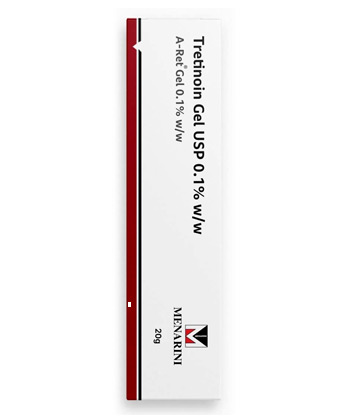
A-ret
- You can buy a-ret from online pharmacies and in many markets it may be available without a prescription, especially in India and some Asian countries; however, in the US, EU, and most other countries it is prescription-only.
- a-ret contains tretinoin, a topical retinoid used mainly for acne vulgaris and also for photoaging and hyperpigmentation. It works by increasing skin cell turnover, helping unclog pores, and reducing the formation of comedones.
- The usual dose is a thin pea-sized amount applied once daily in the evening; common strengths include 0.025%, 0.05%, and 0.1% gel or cream, with lower strengths used if irritation occurs.
- The form of administration is topical, usually as a gel or cream applied to the affected skin.
- It usually starts working gradually, with some improvement in 2–4 weeks, but acne may take 6–12 weeks for noticeable results.
- The duration of action is overnight with once-daily use, and benefits continue only with regular ongoing treatment.
- Avoid alcohol excess if it contributes to skin dryness or irritation; there is no major direct alcohol interaction with topical tretinoin, but oral tretinoin must be managed under medical supervision.
- The most common side effects are skin redness, dryness, peeling, burning, stinging, and temporary worsening of acne at the start of treatment.
- Would you like to try a-ret without a prescription?
Basic a-ret Information
- INN (International Nonproprietary Name): Tretinoin, also known as all-trans-retinoic acid or ATRA.
- Brand names available in United States: Retin-A, Altreno, Atralin, Avita, Renova, Refissa, Tri-Luma, Biacna, Veltin, Vesanoid, and Ziana.
- ATC Code: D10AD01.
- Forms & dosages: Cream 0.025%, 0.05%, 0.1%; gel 0.01%, 0.025%, 0.05%, 0.1%; lotion 0.05%; oral capsule 10 mg for cancer only.
- Manufacturers in United States: Janssen (Johnson & Johnson), Valeant/Bausch Health, and Menarini for some markets.
- Registration status in United States: Prescription only, approved by the US FDA for acne vulgaris.
- OTC / Rx classification: Prescription-only (Rx) in most countries.
Key Findings From Recent Trials
What does the evidence really say about tretinoin, and why do so many patients stick with it after the first rough weeks?
The strongest tretinoin studies from 2022 to 2026 still support what dermatology has known for years: this topical retinoid works for acne and remains one of the best-studied options for photoaging.
Across tretinoin studies, the main acne outcomes are fewer comedones, fewer inflammatory lesions, and gradual improvement in skin texture.
Trial data also keep showing that the early phase is the hardest part for many people, with temporary worsening or “purging” as clogged pores come to the surface before the skin settles down.
That pattern is common with a topical retinoid trial, and it is one reason many patients stop too soon.
For acne, the practical window is usually 6 to 12 weeks before clear improvement shows up, even when the product is working exactly as intended.
For photoaging data, the long-running Retin-A evidence points to smoother texture, softer fine lines, and more even-looking skin over time, especially with consistent nightly use.
Strength matters too, since 0.025%, 0.05%, and 0.1% formulations can differ in both tolerability and how quickly irritation appears, while newer lotion, gel, and cream vehicles aim to improve comfort and adherence.
Safety observations remain familiar: dryness, peeling, redness, stinging, and photosensitivity are the dominant findings.
Retin-A, Altreno, Atralin, Renova, and A-Ret all contain the same active ingredient, but formulation differences can change how the skin feels and how long patients can stay on treatment.
Clinical Mechanism Of Action
Why does a small nightly amount of tretinoin change acne and aging skin over time?
For most patients, the answer is simple: it speeds skin cell turnover, helps unclog pores, and gradually supports smoother skin.
That means fewer comedones and less buildup inside the follicle, but not instant results.
From a scientific standpoint, tretinoin binds to retinoic acid receptors and helps normalize follicular keratinization.
That action addresses a key step in acne pathogenesis and also supports improvements in photodamage.
This is why ATRA mechanism discussions always come back to the same core idea: topical vitamin A changes how skin cells mature and shed.
Formulation matters because cream, gel, and lotion affect irritation and adherence.
A lighter gel such as A-Ret Gel may feel less greasy on oily skin, while a cream like Retin-A is often chosen for drier or more sensitive skin.
Lotions can be a helpful middle ground when a patient wants treatment but cannot tolerate a stronger-feeling vehicle.
Scope Of Approved And Off-Label Use
What can tretinoin be prescribed for in the United States, and what do dermatologists commonly use it for beyond the label?
The US FDA approves tretinoin as a prescription-only treatment for acne vulgaris, and well-known brands include Retin-A, Altreno, Atralin, Avita, Renova, and Refissa.
In daily practice, off-label anti-aging use is common, especially for photoaging, fine lines, hyperpigmentation, and texture improvement.
That broader use is not surprising, because the same retinoid pathway that helps acne can also improve the look and feel of sun-damaged skin.
Tri-Luma is a different dermatologic product altogether, since it combines tretinoin with other agents for a separate treatment goal.
Real-world access also varies by region.
A-Ret is widely used in India and parts of Asia, often as A-Ret Gel 0.025%, 0.05%, or 0.1% in 20 g aluminum tubes.
In our online pharmacy, a-ret is available without a prescription, with discreet delivery to United States in 5-14 days.
Dosage Strategy
How much tretinoin should go on the skin, and why do so many people accidentally use too much?
The standard answer is a pea-sized amount once nightly for acne, applied to clean, dry skin.
More product does not work better.
It usually just means more irritation, more peeling, and a higher chance that the patient quits early.
For acne vulgaris, nightly use is the usual regimen.
For photoaging, a thin nightly layer is common and often continued for months.
The oral 10 mg capsule is different and belongs to oncology protocols only, not acne care.
Age and sensitivity matter too.
Tretinoin is approved for acne in ages 12 and older, and lower concentrations are preferred if irritation starts to build.
Elderly patients may need slower titration because skin can be more reactive, even when there is no formal dose change.
Safety Protocols
Who should be careful with tretinoin, and when is it better to pause treatment?
Important contraindications include hypersensitivity, pregnancy concerns, eczema, sunburn, and broken or irritated skin.
Topical use in pregnancy is generally not recommended unless the benefits outweigh the risks.
Severe caution also applies when the skin barrier is already inflamed, because retinoid dermatitis can become hard to tolerate.
The expected side-effect pattern is very recognizable: redness, peeling, burning, dryness, and an initial acne flare.
Severe allergy is rare, but it is a reason to stop and call a clinician right away.
Risk reduction is straightforward and practical.
Start with a lower strength, use moisturizer, reduce frequency if needed, and wear daily sunscreen.
That last step is nonnegotiable because tretinoin increases photosensitivity and sun exposure makes irritation worse.
Interaction Mapping
Does tretinoin interact with food, and what should be avoided on the skin at the same time?
Topical tretinoin has no meaningful food interactions.
Oral tretinoin is a cancer medicine and must be used only under specialist instructions.
On the skin, the bigger concern is additive irritation.
Benzoyl peroxide, exfoliating acids, abrasive cleansers, and other retinoids can make the face much more sensitive when used together.
Photosensitizing medicines also deserve caution, especially if the patient has a lot of UV exposure or uses light-based treatments.
Combination products can be useful when prescribed for the right reason.
Ziana and Tri-Luma are real examples, but they are not interchangeable with plain tretinoin and should be used under clinician supervision.
Patient Experience Analysis
Why do some people swear by tretinoin while others stop after two weeks?
Survey patterns and everyday pharmacy conversations point to the same story: acne often improves over time, but early dryness and peeling drive a lot of discontinuation.
That is the tricky part of the patient experience.
The medicine can be working, yet the skin looks worse before it looks better.
Online searches reflect that reality, with people looking for A-Ret Gel 0.05% online, Retin-A cream reviews, and “how to purge on tretinoin.”
Many patients do better with a lotion or a lower-strength gel when irritation limits use.
Consistency matters more than racing to a higher strength.
That is often the difference between a treatment that gets abandoned and one that becomes part of a routine.
Distribution And Pricing Landscape
Why does tretinoin cost so differently from one pharmacy to another?
The market includes Retin-A, Altreno, Atralin, Avita, Renova, Refissa, A-Ret, Biacna, Veltin, and generic tretinoin, with support from companies such as Janssen, Bausch Health, Menarini, Sun Pharma, and Akums.
Prices vary by country, formulation, brand status, and whether the product is sold through a prescription channel or a broader online supply chain.
That is why shoppers may see very different pricing for the same strength in cream, gel, or lotion form.
Online pharmacies and cosmetic supply channels can widen access, but source quality still matters.
Packaging also differs.
Twenty-gram tubes are common in India, while many gels in other markets come in 15 g to 20 g tubes.
If a customer is comparing products, it is worth checking the vehicle, the strength, and the manufacturer before deciding based on price alone.
Alternative Options
What if tretinoin is too irritating, or what if the skin needs a different retinoid approach?
Adapalene, tazarotene, topical isotretinoin, and combination acne products are the main comparison points.
Adapalene is often used when people want a gentler retinoid option, and Differin is a familiar name in that category.
Tazarotene can be stronger but may be more irritating.
Topical isotretinoin is another retinoid alternative, while combination products may add antibiotics or benzoyl peroxide for acne control.
Tretinoin remains the classic benchmark because of its strong evidence base and broad recognition in acne and photoaging care.
Users who cannot tolerate tretinoin often do better with adapalene, while more treatment-resistant photoaging or acne may need a dermatologist-guided alternative.
When the skin is very sensitive, the vehicle choice can matter as much as the drug itself.
Regulatory Status
Is tretinoin easy to buy everywhere, or does the legal status change by country?
In the United States and most EU or EEA markets, tretinoin is Rx-only.
That means a prescription is normally required.
In India, CDSCO-registered tretinoin brands such as A-Ret may be widely available, and local rules can make access easier than in North America.
Globally, the ATC code is D10AD01, which classifies it as a dermatological anti-acne retinoid for topical use.
Romania’s ANMDMR records prescription products, while Russia and Ukraine may have easier online availability through registered suppliers.
In practical terms, shoppers in the United States should expect tretinoin to be treated as a prescription medicine, even when online access appears broad.
Consolidated FAQ
How long until tretinoin works?
Most acne improvement takes 6 to 12 weeks, and some people need maintenance use after that.
Can I use it every night?
Nightly use is common, but if irritation builds, frequency can be reduced until the skin adjusts.
Why is my skin peeling?
Peeling is a very common side effect and usually means the skin barrier is adjusting to increased cell turnover.
Is A-Ret the same as Retin-A?
They contain the same active ingredient, tretinoin, but they may differ in formulation, strength, and packaging.
Is A-Ret Gel 0.05% the same as a topical vitamin A cream for acne?
It is the same treatment family, but the vehicle and exact strength matter for comfort and results.
For shoppers comparing a tretinoin acne gel, Retin-A cream, or another brand, sunscreen and patience are still part of the treatment plan.
Visual Guide
What does the skin usually look like as tretinoin starts to work?
During week 1 to 2, dryness and tightness are common.
Between week 3 and 6, a flare can happen as clogged pores surface.
By week 6 to 12, acne is often calmer and skin texture starts to look smoother.
Application is simple but important: use a pea-sized amount, avoid the eyes and corners of the mouth, and apply only to fully dry skin.
Gels usually suit oily skin, creams suit dry or sensitive skin, and lotion is often the most cosmetically elegant.
That is why the best formulation is often the one the patient can actually keep using.
Storage And Transport
How should tretinoin be stored so it stays stable?
Keep it at room temperature, 20° to 25°C, with the tube or bottle tightly closed.
Do not freeze it.
Keep it away from children, heat, flame, and direct sunlight.
Gels are flammable, so transport should avoid hot cars, open flames, and prolonged sun exposure.
Aluminum tubes, which are common for A-Ret, help protect the formula, but the cap still needs to be sealed properly after each use.
Guidelines For Proper Use
What is the safest routine for getting the most from tretinoin?
Start with gentle cleansing, then wait until the skin is dry before applying a small amount.
Moisturizer can be used after treatment if needed, especially in the early weeks.
If a dose is missed, apply it when remembered unless the next dose is close; do not double up.
Severe burning, swelling, blistering, or suspected allergy needs medical review.
Those warning signs are not the same as normal dryness or mild peeling.
Patients who stay consistent, keep the amount small, and protect their skin from the sun usually do best with this medicine.
Delivery Across United States
| City | Region | Delivery time |
|---|---|---|
| New York | Northeast | 5-7 days |
| Los Angeles | West | 5-7 days |
| Chicago | Midwest | 5-7 days |
| Houston | South | 5-7 days |
| Phoenix | West | 5-7 days |
| Philadelphia | Northeast | 5-7 days |
| San Antonio | South | 5-7 days |
| San Diego | West | 5-7 days |
| Dallas | South | 5-7 days |
| San Jose | West | 5-7 days |
| Austin | South | 5-7 days |
| Jacksonville | South | 5-9 days |
| Columbus | Midwest | 5-9 days |
| Indianapolis | Midwest | 5-9 days |
| Charlotte | South | 5-9 days |