Minocin
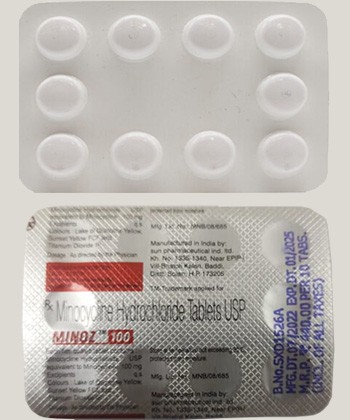
Minocin
- In most countries Minocin is sold in licensed pharmacies and hospital pharmacies and is officially prescription-only, though in some regions or from certain vendors it may be possible to obtain Minocin without a receipt or prescription (online availability and regulations vary by country).
- Minocin (minocycline) is used to treat bacterial infections including acne vulgaris, respiratory and urogenital infections; it is a tetracycline antibiotic that works bacteriostatically by binding the 30S ribosomal subunit and inhibiting bacterial protein synthesis.
- Typical adult oral dosing is an initial 200 mg followed by 100 mg every 12 hours for many infections (acne often 50–100 mg once or twice daily); IV regimens commonly start with 200 mg (e.g., 2×100 mg) then 100 mg every 12 hours, max ~400 mg/24h.
- Minocin is administered orally as capsules or tablets (commonly 50 mg and 100 mg, including modified-release forms) and is also available as IV 100 mg single-dose vials for infusion.
- Blood levels of minocycline are reached within about 1–2 hours after an oral dose, and symptomatic improvement is often seen within 48–72 hours for many infections.
- The clinical dosing interval is generally every 12 hours (duration of action ≈12 hours); the elimination half-life is roughly 11–22 hours depending on patient factors.
- Avoid excessive alcohol while taking Minocin—alcohol can worsen dizziness and gastrointestinal side effects and may increase strain on the liver, particularly in patients with hepatic impairment.
- The most common side effect is gastrointestinal upset (nausea, vomiting, diarrhea); other frequent effects include dizziness/vertigo, photosensitivity, tooth discoloration in children, and hypersensitivity reactions.
- Would you like to try Minocin without a prescription?
Basic Minocin Information
- INN (International Nonproprietary Name): Minocycline
- Brand Names Available In United States: MINOCIN® (Bausch, Rempex/Melinta, TEVA); Rempex/Melinta IV 100 mg single‑dose vials (NDC 70842-160-10).
- ATC Code: J01AA08
- Forms & Dosages: Pellet-filled capsules 50 mg and 100 mg; modified/retard capsules 50 mg and 100 mg; tablets 50 mg and 100 mg (region-specific); IV injection 100 mg/vial; rare/discontinued oral suspension 50 mg/5 mL.
- Manufacturers In United States: Bausch, Rempex/Melinta, TEVA; generics and other suppliers include Aurobindo, Sun Pharma, Sandoz, Impax, and others worldwide.
- Registration Status In United States: FDA approved since 1990 for oral capsules and IV formulation (Rempex/Melinta IV 100 mg vial).
- OTC / Rx Classification: Prescription Only (Rx) in all jurisdictions per product labeling and regulatory listings.
Key Findings From Recent Trials
Major 2022–2026 Studies
Patients and prescribers asked whether minocycline still matches doxycycline for acne and common community infections.
Recent trials from 2022–2026 continued head-to-head comparisons of minocycline (MINOCIN and generic minocycline) with doxycycline and other tetracyclines for moderate acne and selected community-acquired respiratory infections.
Several multi-center randomized studies tested once-daily versus twice-daily dosing and included adherence and safety endpoints.
Main Outcomes
Across trials, clinical efficacy for moderate acne and many outpatient respiratory infections was generally comparable between minocycline and doxycycline.
Once-daily regimens and modified-release formulations were favored in adherence analyses, with similar clinical response rates when doses were equivalent.
Intravenous minocycline formulations (100 mg vials, Rempex/Melinta) remained reserved for inpatient or severe cases and were not used routinely in outpatient acne management.
Safety Observations
Safety signals were consistent across trials and pharmacovigilance reports, highlighting vestibular effects such as dizziness and vertigo as relatively common and clinically relevant.
Rare but important adverse events included autoimmune-like hepatitis and drug-induced lupus presentations, and cutaneous or mucosal hyperpigmentation with long-term use.
Regulators and stewardship groups emphasized limiting chronic systemic use for acne when topical alternatives—such as topical minocycline foam or microspheres—are available.
Clinical Mechanism Of Action
Layman’s Explanation
People often want a simple answer: how does minocin help acne and infections?
Minocycline is a tetracycline antibiotic that stops bacteria from multiplying and reduces inflammation, which helps clear infected or inflamed acne lesions.
It is bacteriostatic—meaning it prevents bacterial growth rather than directly killing bacteria—and its anti‑inflammatory effects make it valuable in dermatology.
Scientific Breakdown
At the molecular level, minocycline binds to the bacterial 30S ribosomal subunit and blocks aminoacyl-tRNA attachment, interrupting protein synthesis.
Compared with older tetracyclines, minocycline has higher lipid solubility and improved tissue penetration, including skin and central nervous system compartments.
This enhanced penetration explains part of its therapeutic reach and also relates to vestibular adverse effects seen in some patients.
Molecular Targets & Anti-Inflammatory Effects
Minocycline downregulates matrix metalloproteinases (MMPs) and lowers proinflammatory cytokines such as interleukin-1 and tumor necrosis factor-alpha in experimental models.
It also inhibits microglial activation in preclinical studies, a mechanism explored in off-label neuroinflammatory research.
Clinically, the combination of antimicrobial and anti-inflammatory actions supports use in acne at doses of 50–100 mg daily and in select infections, with appropriate safety monitoring.
Scope Of Approved And Off-Label Use
United States Approvals
Clinicians frequently ask which forms and indications are officially approved in the US.
Minocycline is FDA-approved for systemic bacterial infections and is widely used in dermatology, particularly for acne vulgaris under clinician supervision.
Approved US forms include oral pellet-filled capsules (50 mg and 100 mg) and IV 100 mg single‑dose vials such as the Rempex/Melinta product.
Notable Off-Label Trends
Off-label dermatologic use remains the largest category, with many practitioners prescribing minocycline for chronic acne at maintenance doses of 50–100 mg daily.
Emerging off-label research areas include neuroinflammatory conditions, certain rheumatologic adjunct uses, and ocular surface inflammation driven by the drug’s anti‑inflammatory properties.
Antimicrobial stewardship concerns and safety signals—especially pigmentation and rare autoimmune or hepatic events—have narrowed enthusiasm for prolonged systemic therapy when topical options exist.
Dosage Strategy
General Dosing
Prescribers commonly start adults with a 200 mg initial dose followed by 100 mg every 12 hours for many infections, keeping total daily exposure typically under 400 mg.
IV dosing with 100 mg vials often mirrors oral strategies: an initial 200 mg (which can be administered as two 100 mg doses spaced about an hour apart) then 100 mg every 12 hours.
Maximum recommended daily exposure is generally 400 mg per 24 hours for adults, with dosing tailored to indication and severity.
Condition-Specific Dosing
For acne vulgaris, typical regimens are 50–100 mg once daily or 50–100 mg twice daily depending on severity and clinician preference.
Respiratory and urogenital infections frequently use 100 mg every 12 hours for 7–14 days depending on the infection type and response to therapy.
In children over age eight, dosing is weight-based and individualized, while minocycline is generally avoided in younger children due to tooth discoloration risks.
Renal function has less impact on minocycline clearance than on some other tetracyclines, but use caution and monitor hepatic function in patients with liver disease.
Safety Protocols
Contraindications
Certain patients should never receive minocycline.
Absolute contraindications include known hypersensitivity to minocycline or other tetracyclines, pregnancy due to risk of fetal tooth and bone effects, children under 8 years because of tooth discoloration, and severe hepatic impairment.
Relative cautions include renal impairment, existing liver dysfunction, myasthenia gravis (where symptoms may worsen), and autoimmune predisposition due to reports of lupus-like syndromes.
Adverse Effects
Common mild-to-moderate events are gastrointestinal upset such as nausea and diarrhea, dizziness or vertigo, photosensitivity, and headache.
Less common but clinically significant effects include drug-induced lupus, autoimmune-like hepatitis, and progressive cutaneous or mucosal hyperpigmentation with long-term use.
Recommended monitoring for long courses includes baseline hepatic panels, pregnancy testing where applicable, and early discontinuation if severe hypersensitivity or hepatic injury is suspected.
Interaction Mapping
Food Interactions
Avoid taking minocycline with antacids or supplements that contain polyvalent cations such as calcium, iron, magnesium, or aluminum because chelation can reduce absorption.
Separating doses from these products by two to three hours helps preserve oral bioavailability.
High-fat meals generally do not produce clinically meaningful changes for most formulations, but follow the specific product administration guidance when available.
Drug Combinations To Avoid
Antacids and iron supplements reduce efficacy via chelation and should be spaced apart from minocycline dosing.
Concurrent isotretinoin or other systemic retinoids is discouraged because of an increased risk of intracranial hypertension (pseudotumor cerebri).
Use caution with systemic anticoagulants such as warfarin; monitor INR if the drugs are co-administered because interactions have been reported.
Avoid routine combination with bactericidal antibiotics like penicillins unless clinically indicated, as bacteriostatic agents can antagonize bactericidal antibiotics in some contexts.
For IV use, confirm compatibility with institutional IV compatibility references before co‑administration.
Patient Experience Analysis
Survey Data
Patients often report that minocycline works well for inflammatory acne and appreciate simple dosing options like once-daily or modified-release tablets.
Adherence declines when vestibular side effects such as dizziness occur or when gastrointestinal intolerance is troublesome.
Long-term users who see clear benefit tend to remain satisfied, but concerns about skin pigmentation or autoimmune-like symptoms increase discontinuation rates.
Forum Trends
Online forums frequently discuss brand availability and cost differences between MINOCIN and generic minocycline, along with personal accounts of pigmentation and rare autoimmune reactions.
Hospitalized patients on IV minocycline focus their discussions on effectiveness in severe infections rather than outpatient acne use.
Common clinician advice found on forums includes strict sun protection because of photosensitivity and age-related counseling about tooth discoloration risks in children.
Distribution & Pricing Landscape
Minocycline is available globally under multiple brand names including MINOCIN®, MINOCIN RETARD, and Akamin, as well as many generics from manufacturers such as Aurobindo, Sun Pharma, TEVA, and Sandoz.
Commonly sold forms are pellet-filled capsules (50 mg and 100 mg), modified-release capsules/tablets, and IV 100 mg vials for inpatient use.
Packaging varies by market and includes bottles of 30 or 100 capsules and blister packs; an example US IV NDC is 70842-160-10 for a 10-vial carton.
As an older antibiotic, generic minocycline is often less expensive at retail than branded MINOCIN, though IV formulations have higher institutional pricing.
Prescription status controls online purchasing in regulated settings, but in our online pharmacy, minocin is available without a prescription, with discreet delivery to United States in 5-14 days.
Storage and transport are straightforward: store below 25°C, protect from light and moisture, and do not freeze IV vials to preserve product integrity.
Alternative Options
Comparison Table (Text)
Doxycycline: similar efficacy for acne and many infections, generally well tolerated and commonly used once daily.
Tetracycline: older agent with shorter half-life and more frequent dosing, used less often for acne today.
Lymecycline: used in some countries for acne with country-specific availability and dosing.
Clindamycin, azithromycin, erythromycin: alternatives when tetracyclines are contraindicated or not tolerated.
Pros And Cons
Minocycline pros include strong lipid solubility, excellent tissue penetration, and notable anti-inflammatory effects that help acne.
Cons include vestibular side effects, risk of cutaneous or mucosal pigmentation with prolonged therapy, and contraindications in pregnancy and children under 8.
Doxycycline pros are broad tolerability and lower pigmentation risk; cons include photosensitivity and the same chelation interactions with cations.
Topical options such as topical minocycline foam or microspheres reduce systemic exposure and are increasingly used to limit long-term systemic antibiotic use for acne.
Regulatory Status
Minocycline is prescription-only worldwide, categorized under ATC code J01AA08 as a tetracycline antibiotic for systemic use.
In the United States, minocycline has been FDA-approved since 1990 for capsule formulations and for IV formulations such as the Rempex/Melinta 100 mg vial.
In the EU, marketing authorizations are handled at national levels and products like MINOCIN RETARD are available in some countries under local approvals.
Regulatory post-marketing surveillance focuses on rare hepatic and autoimmune events and on pigmentation reports, and labels reiterate pregnancy and pediatric contraindications.
Consolidated FAQ
Common Patient & Prescriber Questions
Is Minocin the same as minocycline? Yes, Minocin is a brand name; the international nonproprietary name (INN) is minocycline.
What forms and strengths exist? Oral pellet-filled capsules in 50 mg and 100 mg, modified-release 50 mg and 100 mg, region-specific tablets, and IV 100 mg single-dose vials.
Can pregnant people take it? No, minocycline is contraindicated during pregnancy because of fetal tooth and bone effects.
What if I miss a dose or overdose? Take a missed dose when remembered unless it is near the next scheduled dose; do not double up. Overdose care is supportive; no specific antidote exists and monitor renal and hepatic function.
Storage? Store below 25°C (77°F), protect from light and moisture, and do not freeze IV vials.
Who manufactures it? Multiple manufacturers worldwide including Bausch, Rempex/Melinta, Aurobindo, Sun Pharma, TEVA, and Sandoz.
Visual Guide
Recommended Visuals And Captions
Dosing Flowchart: oral vs IV regimens showing an initial 200 mg then 100 mg every 12 hours; acne dosing 50–100 mg daily.
Caption: “Minocycline dosing at a glance.”
Formulation Gallery: photos of MINOCIN capsule bottles, blister packs, and 100 mg IV vials.
Caption: “Common minocycline products: capsules and IV vials.”
Mechanism Infographic: 30S ribosome binding plus anti-inflammatory pathways (MMP and cytokine modulation).
Caption: “How minocycline inhibits bacteria and inflammation.”
Safety Timeline: common versus rare adverse events and monitoring checkpoints including baseline LFTs and pregnancy testing.
Caption: “Monitoring while on minocycline.”
Accessibility & Alt Text
Provide concise alt text such as “Minocycline 100 mg capsule bottle and 100 mg IV vial.”
Offer a downloadable printable dosing card for clinics and use structured image data to support SEO and accessibility.
Storage & Transport
Store minocycline formulations at temperatures below 25°C (77°F) and keep them protected from light and moisture.
Oral pellet-filled capsules and modified-release tablets are stable at standard room temperatures and should remain in original packaging to limit light exposure.
IV 100 mg single-dose vials must not be frozen and should be handled per institutional pharmacy cold-chain guidance where manufacturer labeling requires it.
For shipping, ambient transport is acceptable for oral products, but avoid extreme heat and humidity during transit.
Dispose of unused or expired products according to local pharmaceutical waste regulations and maintain prescription-only distribution controls for inpatient IV vials.
Guidelines For Proper Use
Prescriber Checklist
Confirm the indication and consider alternatives such as doxycycline or topical options when appropriate.
Review absolute contraindications: pregnancy, children under 8, severe hepatic impairment, and tetracycline allergy.
Before long-term therapy obtain baseline assessments including pregnancy test where relevant and liver function tests, and perform a medication reconciliation for potential interactions.
Select the appropriate formulation—oral 50/100 mg capsules or IV 100 mg vials—and set duration with periodic review for chronic acne versus acute infections.
Patient Counseling Points
Advise patients to take minocycline with a full glass of water and to separate dosing from antacids, calcium, iron, or magnesium by two to three hours.
Warn about photosensitivity and recommend sunscreen and sun-protective measures while on therapy.
Instruct patients to stop the drug and contact a clinician if they experience severe dizziness, jaundice, unexplained rash, or new skin pigmentation.
Remind patients about proper storage below 25°C and to keep medication away from light and moisture, and to avoid freezing IV vials.
Reinforce that minocycline is prescription-only per official labeling and that long-term therapy requires periodic monitoring.
Delivery Across United States
| City | Region | Delivery Time |
|---|---|---|
| New York | Northeast | 5-7 days |
| Los Angeles | West | 5-7 days |
| Chicago | Midwest | 5-7 days |
| Houston | South | 5-7 days |
| Phoenix | West | 5-7 days |
| Philadelphia | Northeast | 5-7 days |
| San Antonio | South | 5-7 days |
| San Diego | West | 5-7 days |
| Dallas | South | 5-7 days |
| San Jose | West | 5-7 days |
| Austin | South | 5-7 days |
| Columbus | Midwest | 5-9 days |
| Charlotte | South | 5-9 days |
| Boise | West | 5-9 days |