
Metronidazole
Metronidazole
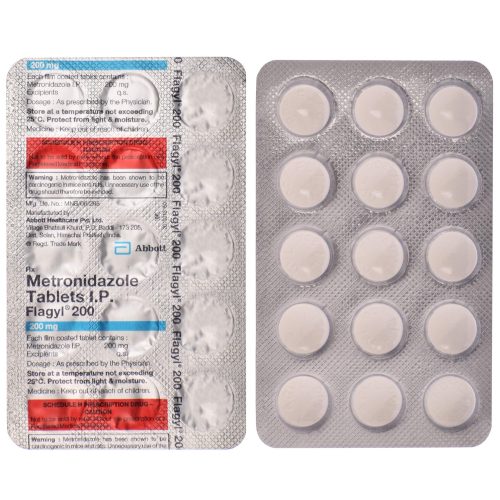
- Metronidazole is commonly available in pharmacies and online from many brands worldwide, including Flagyl, Metrogel, and Noritate. However, in most countries it is prescription-only (Rx); some pharmacies may offer it without a prescription depending on local rules.
- Metronidazole is used to treat anaerobic bacterial infections, bacterial vaginosis, trichomoniasis, amoebiasis, giardiasis, and certain dental and gastrointestinal infections. It works by entering microbial cells and damaging their DNA, which stops the organisms from growing and kills them.
- The usual adult dose depends on the infection: 500 mg every 8 hours for anaerobic infections, 2 g once or 250 mg three times daily for trichomoniasis, and 500–750 mg three times daily for amoebiasis or giardiasis. For children, dosing is typically weight-based at 7.5 mg/kg every 8 hours.
- Metronidazole comes as oral tablets, extended-release tablets, capsules, oral suspension, IV injection, topical cream/gel, and vaginal gel or suppositories.
- Metronidazole usually starts working within a few hours, but symptom improvement may take 1–3 days depending on the infection and the form used.
- The duration of action is generally several hours per dose, and treatment courses usually last 3–7 days for many infections, with some severe infections requiring up to 10–14 days.
- Do not drink alcohol while taking metronidazole and for at least 48 to 72 hours after the last dose, because it can cause a disulfiram-like reaction with nausea, vomiting, flushing, and headache.
- The most common side effects are nausea, metallic taste, vomiting, diarrhea, headache, dizziness, and dark-colored urine.
- Would you like to try metronidazole without a prescription?








Key Recent Evidence And Treatment Trends
Wondering why metronidazole is still prescribed so often when newer options keep appearing?
That question comes up a lot from patients who have already heard the name Flagyl, seen Metrogel on a skin-care shelf, or been told they need an IV antibiotic in the hospital.
From 2022 through 2026, the clinical picture has stayed remarkably consistent: metronidazole remains a dependable choice for anaerobic infections, bacterial vaginosis, trichomoniasis, and protozoal gastrointestinal disease.
Real-world use continues across oral Flagyl tablets, topical Metrogel products, and hospital IV formulations, because the drug is still effective where oxygen-free organisms and certain protozoa are involved.
That durability is also why metronidazole remains a prescription-only medicine globally, with stewardship and resistance concerns shaping access in nearly every market.
Major 2022–2026 Studies
Recent metronidazole evidence has not displaced the drug, but it has sharpened how clinicians use it.
The strongest support still centers on bacterial vaginosis, trichomoniasis, and anaerobic coverage, especially when the infection profile matches metronidazole’s spectrum.
Product data continue to support common adult regimens such as 500 mg IV or by mouth every 8 hours for 7 to 10 days for anaerobic infections, and 2 g once or 250 mg three times daily for 7 days for trichomoniasis.
For rosacea, topical 0.75% metronidazole remains a familiar twice-daily option used over several weeks.
Clinicians still rely on metronidazole 500 mg tablets when oral therapy is appropriate, while hospital teams continue to use Flagyl IV for severe disease or patients who cannot take oral medicine.
Main Outcomes
Across recent practice trends, the most reliable outcomes continue to be seen in bacterial vaginosis, trichomoniasis, and anaerobic infections.
Those indications keep metronidazole in routine use because the clinical response is predictable when the diagnosis is correct.
Stewardship remains central, since unnecessary exposure can contribute to resistance pressure and avoidable adverse effects.
That is one reason metronidazole evidence is often discussed alongside careful patient selection rather than broader antibiotic use.
Safety Observations
The most common adverse effects remain nausea, metallic taste, diarrhea, headache, and dizziness.
With longer or repeated exposure, clinicians pay closer attention to CNS effects and peripheral neuropathy.
Patients who have taken repeated courses of Flagyl studies often mention taste disturbance first, but neurologic symptoms are the bigger concern if therapy is prolonged.
That pattern is also why Metrogel trends remain favorable for some patients, since topical use can reduce systemic exposure when the condition allows it.
Basic Metronidazole Information
- INN (International Nonproprietary Name): Metronidazole.
- Brand names available in United States: Flagyl, Noritate, Metrogel.
- ATC Code: J01XD01.
- Forms & dosages: Tablets 200 mg, 250 mg, 400 mg, 500 mg; extended-release 750 mg; capsules 375 mg; oral suspension 200 mg/5 mL or 400 mg/5 mL; IV injection 500 mg/100 mL and 5 mg/mL vials; topical cream 0.75% and 1%; vaginal gel 0.75% and 1%.
- Manufacturers in United States: Pfizer, Galderma Labs, Fougera, Taro, Teva.
- Registration status in United States: Approved by the FDA.
- OTC / Rx classification: Prescription Only (Rx).
Clinical Mechanism Of Action
Ever wonder why metronidazole works so well for infections that standard antibiotics sometimes miss?
The answer starts with the organisms it targets.
Metronidazole works against certain bacteria and parasites that thrive without oxygen, which is why it is especially useful in anaerobic and protozoal infections.
After the drug enters susceptible organisms, it is activated into metabolites that damage microbial DNA.
That DNA injury explains the broad clinical use of the metronidazole antibiotic in Flagyl IV, oral tablets, capsules, and topical forms such as Metrogel and Noritate.
Layman’s Explanation
In plain language, metronidazole is a medicine that goes after the kinds of germs that like low-oxygen environments.
That includes many anaerobic bacteria and some protozoa, so it is often chosen when an infection is not responding to the usual first-line antibiotic plan.
For a patient with bacterial vaginosis or trichomoniasis, that can mean a treatment that is targeted rather than overly broad.
For a hospitalized patient with an anaerobic infection, it can mean a fast, practical option while the care team narrows the diagnosis.
Scientific Breakdown
Metronidazole is classified as ATC J01XD01, an imidazole derivative under antibacterials for systemic use.
Once activated inside susceptible organisms, the drug’s metabolites disrupt DNA integrity and lead to microbial death.
That mechanism supports its use as anaerobic coverage in systemic infections and helps explain why the same molecule is available in oral, IV, and topical routes.
In practice, the route depends on the infection site, severity, and whether the patient needs local treatment like Metrogel or systemic therapy like Flagyl IV.
Scope Of Approved And Off-Label Use
Looking at the label and real-world prescribing, metronidazole has a wider footprint than many people expect.
In the United States, brand names include Flagyl, Noritate, and Metrogel, and the available forms include tablets, capsules, extended-release tablets, IV injection, topical cream, and vaginal gel.
Common clinical use extends to bacterial vaginosis, trichomoniasis, anaerobic infections, dental abscess, amoebiasis, giardiasis, and H. pylori regimens where appropriate.
Topical metronidazole is also widely used for rosacea, while vaginal products are used for gynecologic infections.
In our online pharmacy, metronidazole is available without a prescription, with discreet delivery to United States in 5-14 days, which matters for patients who want privacy and steady access.
United States Approvals
U.S. product availability is broad enough that pharmacists often see multiple formulations in the same week.
Oral metronidazole tablets, including metronidazole 500 mg tablets, are used for systemic infections and trichomoniasis.
Metrogel and Noritate support skin and vaginal care depending on the product type and concentration.
That variety helps patients match route to condition without changing the underlying active ingredient.
Notable Off-Label Trends
Clinical practice also includes use in dental abscesses, protozoal GI infections, and some combination regimens such as H. pylori triple therapy.
People often ask about metronidazole vaginal gel for gynecologic symptoms because local therapy can be easier to tolerate than pills.
Combination packs also appear in some markets, including Entamizole with diloxanide furoate, which reflects how metronidazole is sometimes paired in parasite-focused treatment plans.
For skin care, many patients search for Flagyl online, Metrogel, or metronidazole cream when they are trying to manage rosacea with a local product.
Dosage Strategy
What dose should a patient expect, and does the number change with the infection?
Yes, it does, and that is where careful counseling matters.
Adult dosing varies by indication and route, while pediatric dosing is weight-based.
For many anaerobic infections, product data list 500 mg IV or by mouth every 8 hours for 7 to 10 days.
For trichomoniasis, common oral regimens are 2 g once or 250 mg three times daily for 7 days.
General Dosing
General dosing should always follow the indication and the chosen formulation.
Children are usually dosed at 7.5 mg/kg by mouth every 8 hours, with a maximum of 500 mg per dose.
Older adults generally use standard adult doses, but they should be watched closely for CNS effects and cumulative toxicity.
That is especially relevant when someone is already taking other medications that can blur neurologic symptoms.
Condition-Specific Dosing
For bacterial vaginosis, common regimens include 500 mg twice daily or 0.75% topical therapy for 5 to 7 days.
For amoebiasis and giardiasis, 500 to 750 mg three times daily is typical for 5 to 10 days.
For rosacea, topical cream or gel is usually applied twice daily for several weeks.
These differences are why a metronidazole dosage chart can be helpful when patients compare tablets, cream, and Metrogel-Vaginal options.
Special Populations
Severe hepatic impairment calls for a 50% dose reduction.
Renal failure usually does not require routine dose adjustment, but dialysis patients need caution and may require supplemental dosing after dialysis.
When a patient asks about Flagyl 375 or metronidazole cream, the route matters as much as the strength because dosing logic changes with each product.
Vaginal gel formulations such as Metrogel-Vaginal can be useful when a local route is preferred.
Safety Protocols
Safety questions usually come up before the first dose, and they should.
Metronidazole is effective, but it is not a medicine to start casually if the patient has a history of allergy, CNS disease, or alcohol use concerns.
Absolute contraindications include known allergy to metronidazole or other nitroimidazoles, and first trimester pregnancy for some indications.
Caution is also warranted in epilepsy, severe hepatic impairment, chronic alcoholism, and in children or pregnancy beyond the first trimester when benefits need to outweigh risks.
Contraindications
A metronidazole allergy can show up as a previous hypersensitivity reaction, so a good medication history is essential.
Product data also flag first trimester pregnancy for some uses, which means the indication and trimester both matter.
Patients with active CNS disorders deserve extra care because neurologic adverse effects can be harder to separate from baseline symptoms.
Adverse Effects
The common side effects are nausea, metallic taste, vomiting, diarrhea, headache, and dizziness.
Some patients notice dark urine, which is usually benign and reversible.
Skin rash, itching, and oral or vaginal candidiasis can occur with prolonged use.
In overdose, nausea, ataxia, seizures, and peripheral neuropathy may appear, and the response is supportive care.
Those are the metronidazole side effects that matter most in daily counseling, especially for patients using Flagyl adverse effects information to decide whether to continue therapy.
Interaction Mapping
The biggest interaction question is simple: can you drink alcohol?
With metronidazole, the answer is no during treatment because the drug can cause a disulfiram-like reaction when alcohol is consumed.
That includes hidden alcohol in mouthwash, cough syrups, and combination products, so label reading matters more than many patients realize.
Other drug combinations can raise CNS toxicity risk, especially during prolonged therapy or in older adults.
Because of that, metronidazole precautions should always be reviewed with the full medication list in hand.
Food Interactions
Alcohol is the food and beverage issue that gets the most attention, and for good reason.
A patient who takes metronidazole with beer, wine, liquor, or even an alcohol-containing product may feel significantly worse.
Patients should also be reminded that over-the-counter products can contain alcohol in small but still relevant amounts.
Drug Combinations To Avoid
Some combinations may worsen CNS effects, so monitoring becomes more important in long courses.
Combination therapy can still be appropriate, but it needs to be indication-specific and resistance-aware.
That is one reason metronidazole tablets are still commonly prescribed with a clear duration, rather than as open-ended therapy.
When people search metronidazole alcohol interaction or Flagyl precautions, they are usually trying to avoid a bad experience more than a rare reaction.
Patient Experience Analysis
What do patients notice first when they actually start the medicine?
Most often, it is the metallic taste and mild nausea.
Those two effects come up repeatedly because they are easy to feel and hard to ignore.
People using Metrogel often report better convenience because the treatment stays local, and many prefer that to a pill when the indication allows it.
For some, the difference between oral and topical therapy is simply which option they can stick with long enough to finish.
Survey Data
Across patient reports, the most noticeable effects are taste changes and mild stomach upset.
That is why adherence can be a challenge when someone is trying metronidazole cream versus metronidazole tablets.
Topical users often like Metrogel or Metrocream because the treatment is simpler and does not affect every meal.
For rosacea, that can be the difference between stopping early and completing several weeks of therapy.
Forum Trends
Online searches still cluster around dosing, alcohol avoidance, and price.
Common queries include “metronidazole tablets 500mg price,” “Flagyl online,” and “Buy Metrogel.”
Patients also search country-specific names such as Flagyl, Metrogyl, and Trichozole when they are comparing pharmacy listings.
That pattern tells us the main concerns are practical: cost, convenience, and whether the product will arrive on time.
Distribution And Pricing Landscape
Metronidazole is one of those medicines that feels almost everywhere at once.
It is widely distributed in the USA, UK, Canada, India, Bangladesh, Pakistan, Egypt, Italy, Australia, and Spain.
Major manufacturers include Pfizer, Teva, Zydus Lifesciences, Galderma, Abbott, Baxter, Aurobindo, B Braun, Hospira, and Hikma.
Regional generics also play a big role, especially for injectable and oral forms that move through public tenders and hospital supply chains.
Price and access queries remain high because patients are comparing Flagyl IV, metronidazole capsules, metronidazole topical products, and Metrogel price listings across pharmacies.
Market Availability
Tablets, capsules, oral suspension, IV injections, topical creams, and vaginal gels are all part of the market landscape.
That range makes metronidazole useful in hospitals, outpatient care, and dermatology or gynecology settings.
Public tenders and generic sourcing often keep the oral and injectable versions more accessible than patients expect.
For pharmacy buyers, the key is matching the exact formulation to the indication so access does not come at the cost of the wrong product.
Packaging And Access
Packaging varies from small topical tubes to larger IV vials and oral bottle formats.
That matters because the same active ingredient can look very different on a shelf.
Patients often identify the product first by the brand name rather than the generic name, especially with Flagyl and Metrogel.
Access is easier when the prescription, route, and duration are clear from the start.
Alternative Options
Should metronidazole always be the first choice?
Not always, but it remains a standard choice for bacterial vaginosis, trichomoniasis, anaerobic infections, and protozoal GI disease.
Depending on the case, clinicians may compare it with tinidazole, ornidazole, secnidazole, or clindamycin.
The best option depends on the route, the infection, and the patient’s tolerance for side effects.
Comparison Table
| Medicine | Main Use | Practical Notes |
|---|---|---|
| Metronidazole | BV, trichomoniasis, anaerobic infections, protozoal GI disease | Strong evidence base, many dosage forms, alcohol restriction |
| Tinidazole | Protozoal and anaerobic infections | Often compared for tolerability and duration |
| Ornidazole | Similar anaerobic and protozoal coverage | Used in some markets more than others |
| Secnidazole | BV and some protozoal infections | Convenient dosing in select cases |
| Clindamycin | Anaerobic and gynecologic infections | Different safety profile and use case |
Pros And Cons
The biggest pros are broad global availability, many dosage forms, a strong evidence base, and low-cost generics.
The biggest cons are taste disturbance, alcohol restriction, CNS toxicity risk, and resistance concerns with repeated use.
For some patients, the choice between metronidazole vs tinidazole or metronidazole vs clindamycin comes down to which side effects they can tolerate and whether topical treatment is enough.
When the condition is rosacea or localized gynecologic disease, Metrogel may be easier to use than an oral alternative.
Regulatory Status
Metronidazole sits in a well-established regulatory category.
It is approved by the FDA, EMA, MHRA, ANMDMR, and similar national agencies worldwide.
In Romania, ANMDMR lists metronidazole in oral, injectable, and topical forms with public product documentation available through the national drug database.
That wide approval history reflects both the medicine’s long clinical track record and the need for clear product monographs.
Approval Landscape
Regulatory approval is broad because the molecule has been used for decades in oral, IV, and topical care.
Patients can often find the same active ingredient under different brand names, including Flagyl and Metrogel, depending on country and route.
For U.S. readers, the most important regulatory point is that tablets, IV products, and most topical or vaginal forms are Rx-only.
That prescription status is part of antimicrobial stewardship, not a barrier created for its own sake.
Prescription Status
Metronidazole is generally prescription only worldwide because of stewardship, resistance, and safety concerns.
That means patients should expect formal medical review before using metronidazole tablets or most vaginal and IV products.
Product access in the U.S. still follows the same basic principle: use the right route, the right duration, and the right indication.
Those rules matter even when a pharmacy listing makes Flagyl feel easy to buy.
Consolidated FAQ
Patients usually ask the same four questions first, and they deserve straightforward answers.
That is especially true when treatment is time-sensitive and the medicine has a few rules people do not want to miss.
Common Questions
What is metronidazole used for?
It treats anaerobic bacterial and protozoal infections, and some topical skin conditions such as rosacea.
Can you drink alcohol with metronidazole?
No, alcohol should be avoided during therapy because of the disulfiram-like reaction risk.
How long does metronidazole take to work?
Timing depends on the indication, with many vaginal infections treated for 3 to 7 days and severe anaerobic disease treated for up to 14 days.
Is metronidazole safe in pregnancy?
Use depends on trimester and indication, and product data flag first trimester caution or contraindication for some uses.
Practical Answers
For most patients, the key is following the exact course instead of stopping when symptoms improve.
That helps reduce relapse and supports resistance reduction.
If nausea, neurologic symptoms, rash, or persistent diarrhea appear, the patient should contact a clinician promptly.
For pregnancy questions, the safest answer is to confirm the indication and trimester before starting.
Visual Guide
A simple visual can make metronidazole easier to understand than a long medication label.
It is helpful to show the different dosage forms side by side so patients can see why a tablet, vaginal gel, or IV vial is not interchangeable.
A good graphic also helps reinforce counseling points like alcohol avoidance and liver dose reduction.
Suggested Infographic Elements
Include tablet, capsule, oral suspension, IV vial, topical cream, and vaginal gel.
Show the main indications next to each form: BV, trichomoniasis, anaerobic infections, rosacea, giardiasis, and amoebiasis.
A dose box for metronidazole 500 mg tablets can help patients connect the prescription to the product they receive.
People searching for a Flagyl visual or a Metrogel guide usually want quick answers before they place an order.
Workflow Diagram
Symptoms should lead to diagnosis, then route selection, dose, duration, counseling, and follow-up.
That workflow keeps the treatment specific rather than generic.
A callout for liver impairment dose reduction and alcohol avoidance can prevent the two most common avoidable mistakes.
When patients see the path laid out clearly, adherence usually improves.
Storage And Transport
Storage is simple, but it still matters.
Tablets, capsules, and cream should be stored at room temperature, 15 to 25°C or 59 to 77°F.
Protect them from heat, freezing, and moisture.
IV vials should be protected from light, and oral or topical forms do not need refrigeration.
Storage Basics
Keeping metronidazole in its original packaging helps preserve stability and labeling.
That is especially useful for households with multiple prescriptions, where a metronidazole cream tube can be mistaken for another topical product.
Room-temperature storage is usually enough for home use.
Patients should avoid bathrooms and hot cars because humidity and heat can shorten product quality.
Transport Guidance
For shipping or travel, the original box or blister pack is the safest choice.
Light protection matters for Flagyl IV storage, while Metrogel storage is more about avoiding heat and moisture.
That guidance is especially useful for patients who order ahead and want the medicine to arrive usable.
Stable packaging makes the medicine easier to verify and use correctly.
Guidelines For Proper Use
Taking metronidazole correctly is what turns a good drug into a useful treatment.
Patients should take it exactly as prescribed and avoid skipping doses unless instructed.
If a dose is missed, it should be taken when remembered unless the next dose is close.
Doubling up is not recommended.
How To Take It
Oral tablets and capsules should be swallowed on schedule, while topical and vaginal products should be used exactly as directed for the local condition.
Patients should finish the full course even if they feel better early.
That matters for infection control and for resistance reduction.
When a patient is using metronidazole vaginal gel or a topical cream, consistency is just as important as the dose itself.
When To Seek Help
Severe nausea, neurologic symptoms, rash, or persistent diarrhea need medical attention.
Signs of overdose such as ataxia, seizures, or peripheral neuropathy should be treated as urgent concerns.
If the patient has liver disease, epilepsy, or heavy alcohol use, a medication review should happen before treatment starts.
Those are the details that make proper use of proper use metronidazole guidance clinically useful instead of just routine.
Patient Counseling Priorities
Avoid alcohol throughout treatment.
Ask about pregnancy, liver disease, and other medications before starting.
Complete the full course to help prevent relapse and resistance.
Those three points are usually enough to prevent most avoidable problems with Flagyl instructions and metronidazole missed dose confusion.
Delivery Across United States
| City | Region | Delivery Time |
|---|---|---|
| New York City | Northeast | 5-7 days |
| Los Angeles | West | 5-7 days |
| Chicago | Midwest | 5-7 days |
| Houston | South | 5-7 days |
| Phoenix | West | 5-7 days |
| Philadelphia | Northeast | 5-7 days |
| San Antonio | South | 5-7 days |
| San Diego | West | 5-7 days |
| Dallas | South | 5-7 days |
| San Jose | West | 5-7 days |
| Austin | South | 5-7 days |
| Jacksonville | South | 5-9 days |
| Columbus | Midwest | 5-9 days |
| Charlotte | South | 5-9 days |
| Seattle | West | 5-9 days |
For patients comparing access, the usual search terms are metronidazole tablets 500mg price, Flagyl online, and Buy Metrogel.
Those searches are driven by the same concerns every time: speed, privacy, and whether the correct form is in stock.