Podowart
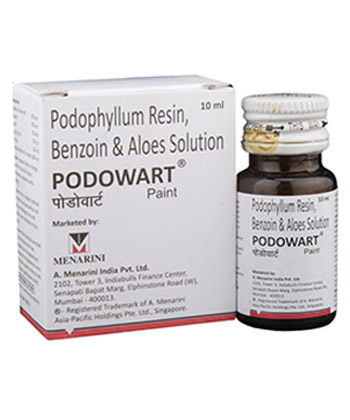
Podowart
- In our pharmacy, you can buy Podowart (podophyllum/podophyllotoxin topical) without a prescription, with delivery in 5–14 days throughout the United States and select regions; discreet and anonymous packaging is available (note: local regulations vary and some countries require a prescription).
- Podowart is used to treat external warts (genital/anal and plantar warts); podophyllotoxin/podophyllum resin is an antimitotic agent that binds to tubulin and inhibits cell division, causing wart tissue necrosis.
- Usual dosages: for podophyllum resin solutions (10%–25%) professional application once weekly up to ~6 weeks; for podophyllotoxin 0.5% gel/cream self-application twice daily for 3 days then 4 days off, repeat up to 4 cycles (do not exceed ~6 weeks continuous use).
- Form of administration: topical only — resin-based solutions (dropper vials) applied by a healthcare professional, and 0.5% podophyllotoxin cream/gel for patient self-application; apply only to the wart and avoid surrounding healthy skin or mucosa.
- Onset time: local irritation or skin reaction often appears within hours; visible reduction in wart size commonly takes 1–3 weeks and usually after one or more treatment cycles.
- Duration of action: topical effects are short-lived (hours–days); therapeutic course is organized in cycles with clearance often achieved within up to 4 cycles (max ~6 weeks), though recurrence can occur and retreatment may be needed.
- Alcohol warning: there is no well-documented direct interaction with alcohol, but avoid alcohol if you develop systemic symptoms of toxicity (nausea, dizziness, altered mental status); do not use during pregnancy (absolute contraindication).
- The most common side effect is local skin irritation — burning, redness, swelling, itching or mild erosion at the application site.
- Would you like to try podowart without a prescription?
Basic Podowart Information
- INN (International Nonproprietary Name): Podophyllotoxin for pure, standardized form; Podophyllum resin or Podophyllin for crude resin extract.
- Brand Names Available In United States: Podocon-25, Podofin, Pododerm (25% topical solution, resin).
- ATC Code: D06BB04 (Podophyllotoxin / Podophyllum resin topical).
- Forms & Dosages: Topical solutions (resin) 10%, 20%, 25% in 3–10 mL vials; topical cream/gel 0.5% in 3–5 g tubes.
- Manufacturers In United States: Not specified in product-info; world-wide suppliers include Meda, Glenmark, Himalaya, Taro, Mylan, Dr. Reddy’s.
- Registration Status In United States: 0.5% podophyllotoxin cream/gel and certain clinic-administered resin solutions are approved for topical wart treatment.
- OTC / Rx Classification: Prescription (Rx) only in most markets; not OTC except rare low-concentration exceptions.
Key Findings From Recent Trials
Major 2022–2026 Studies
Patients and clinicians ask whether podophyllotoxin gel or podophyllum resin works better and which one they should use at home.
Recent comparative trials and evidence syntheses from 2022–2026 focused on externally visible genital warts and perianal lesions.
The published work consistently evaluated standardized 0.5% podophyllotoxin gel applied at home versus clinic-administered podophyllum resin (10–25%).
Trials included randomized comparisons, observational cohorts, and pooled safety surveillance reports.
Main Outcomes
Clinical outcomes show similar clearance rates for external genital warts when podophyllotoxin 0.5% is used twice daily in a 3-days-on/4-days-off schedule, repeated up to four cycles.
Periodic clinic resin applications with wash-off after 1–4 hours produced comparable short-term wart clearance in many studies, especially when applied by experienced clinicians.
Patients using podophyllotoxin gel reported acceptable clearance when adherence to the regimen was good, and clinic treatments often delivered faster visible necrosis but required professional visits.
Safety Observations
Safety endpoints in surveillance cohorts showed predictable local irritation as the most common event for both modalities.
Systemic toxicity remained rare and was strongly linked to off-label use, especially large-area or mucosal application of resin preparations.
Regulatory reports emphasized teratogenic risk and reinforced strict pregnancy contraindication and prescription control in most markets.
Practice trends strengthened in favor of podophyllotoxin 0.5% gels for self-use and reserving 10–25% resin for clinic-administered treatments.
Clinical Mechanism Of Action
Layman’s Explanation
People want to know how these products actually remove warts.
Podophyllotoxin and podophyllum resin work by stopping wart cells from dividing so the treated tissue breaks down over repeated applications.
The treated wart gradually sloughs off as abnormal keratinocytes stop proliferating and die.
Scientific Breakdown
Podophyllotoxin is an antimitotic lignan that binds to tubulin and disrupts microtubule assembly, causing metaphase arrest in rapidly dividing cells.
This mechanism triggers apoptotic pathways in infected keratinocytes, producing focused cytotoxicity against the wart lesion.
Podophyllum resin is a crude extract containing podophyllotoxin plus other lignans and resins, which makes concentration variable and the preparation more irritant.
Topical podophyllotoxin 0.5% shows minimal systemic absorption when limited to external lesions, whereas resin solutions (10–25%) have higher local potency and a greater risk of systemic exposure when misapplied.
The same antimitotic action that clears warts explains common local erosive reactions and accounts for teratogenic risk if systemic exposure occurs.
Scope Of Approved & Off-Label Use
United States Approvals
Clinicians and patients frequently ask which products are approved for home use and which require clinic administration.
In the United States, branded and generic 0.5% podophyllotoxin formulations are approved for external genital and perianal warts and are labeled for topical self-application when indicated.
Resin solutions in concentrations such as 25% are marketed for clinic use and are typically applied only by healthcare professionals.
Brand names present in the US market include Podocon-25, Podofin, and Pododerm for resin solutions.
Notable Off-Label Trends
Clinicians sometimes use podophyllotoxin or resin for plantar or common warts when other treatments fail, but such use is off-label and requires clinical judgement.
Resin use on mucosal surfaces or over wide areas is strongly discouraged because of variable potency and systemic toxicity risk.
In some regions of Asia, OTC availability in practice has prompted off-label self-use and misuse, which drives calls for clearer labeling and regulation.
Across markets the recommended trend is to reserve high-concentration resin for professional application and to endorse 0.5% podophyllotoxin gels for patient-directed regimens.
Dosage Strategy
General Dosing
Two distinct dosing approaches exist depending on formulation and setting.
Podophyllotoxin 0.5% gel or cream is the standardized option for patient self-application and carries a lower risk of systemic exposure when used correctly.
Podophyllum resin solutions (10–25%) are more irritant and are intended for healthcare professionals to apply in clinic settings.
Limiting treated surface area and following recommended treatment windows reduces systemic risk for both preparation types.
Condition-Specific Dosing
For adults with external genital or perianal warts, podophyllotoxin 0.5% is applied twice daily for 3 consecutive days, followed by 4 days off, and the cycle may be repeated up to four times without exceeding roughly six weeks total.
Podophyllum resin at 20–25% is applied by a clinician once weekly, confined to the wart, and washed off after 1–4 hours, with weekly repeats as needed for up to six weeks.
Plantar or heavily keratinized lesions are generally treated by clinicians using resin and often require keratolytic pretreatment and longer follow-up.
Children are typically excluded from podophyllum treatment because of higher absorption risk, and older adults should use these agents with caution due to fragile skin and higher irritation susceptibility.
Safety Protocols
Contraindications
Safety planning starts with identifying absolute contraindications.
Pregnancy is an absolute contraindication; podophyllotoxin and podophyllum resin are teratogenic and embryotoxic.
Other absolute contraindications include known hypersensitivity to podophyllum products and application to mucosal surfaces, open wounds, or inflamed skin.
Relative contraindications include HIV/AIDS, extensive lesions or poor skin barrier conditions such as eczema and psoriasis, and concurrent large-area applications that might increase systemic absorption.
Adverse Effects
Local adverse effects dominate the safety profile and include burning, redness, swelling, itching, pain, and superficial erosion or ulceration at the application site.
Systemic toxicity is rare but can be serious when large-area or mucosal misuse occurs and may present with nausea, vomiting, diarrhea, altered mental status, and bone marrow suppression.
Overdose management begins with immediate cessation, thorough washing of the area, and urgent medical assessment for systemic signs.
Because of these risks, most regulators treat these products as prescription medicines and require clear counseling for safe use.
Interaction Mapping
Food Interactions
Topical podophyllotoxin used correctly on limited external lesions has minimal systemic absorption, so clinically relevant food interactions are negligible.
If systemic exposure is suspected because of extensive application or symptoms, clinicians should evaluate for potential interactions with other medications or substances.
Drug Combinations To Avoid
Avoid combining podophyllotoxin or podophyllum resin with other topical caustics such as concentrated trichloroacetic acid or strong salicylic acid on the same lesion, because additive necrosis increases ulceration and absorption risk.
When there is concern for systemic absorption, avoid concurrent use with systemic myelosuppressive or neurotoxic drugs and monitor blood counts in patients on chemotherapy.
Concurrent use with topical immunomodulators like imiquimod should only occur under clinician supervision because overlapping local irritation can be significant.
Patient Experience Analysis
Survey Data
Patients often prioritize convenience and privacy when choosing a wart treatment.
Surveys indicate that many patients accept the trade-off of short-term local irritation for the convenience of self-applied 0.5% podophyllotoxin gel.
Adherence to the 3-days-on/4-days-off regimen correlates with better clearance rates in patient-reported outcomes.
Compared with repeated clinic visits for cryotherapy or resin application, at-home gel treatment is frequently preferred when the lesion is external and limited in area.
Forum Trends
Online forums and e-pharmacy reviews highlight confusion over product names such as Podowart versus Podofilox and differences in packaging and concentrations across regions.
Anecdotal misuse reports often involve applying resin to mucosa or extensive skin areas and underscore the need for improved labeling and counseling.
Users report faster wart necrosis with clinic resin applications but also note more post-treatment soreness and, in some cases, longer recovery from superficial erosions.
Clear patient education on application limits, pregnancy risk, and wash-off timing tends to reduce adverse experiences shared in public forums.
Distribution & Pricing Landscape
Availability varies by brand, region, and local regulation, with multiple manufacturers and distributors supplying podophyllotoxin and resin products.
Common brands and suppliers in international markets include Meda, Glenmark, Himalaya, Taro, Mylan, and Dr. Reddy’s, with regional labels such as Condyline, Warticon, Wartec, Podowart, and Podofilox.
Resin solutions generally come in 3–10 mL vials, while 0.5% gels are packaged in 3–5 g tubes.
Pricing depends on region, supplier, and whether professional application is required, because clinic-administered resin includes procedural fees.
Our online pharmacy offers podowart without a prescription, with discreet delivery to United States addresses in 5–14 days.
Because prescription status and enforcement vary globally, shoppers should verify local regulations and check product concentration and packaging before purchase.
Alternative Options
Comparison Table (Described)
When patients ask how podophyllotoxin compares to other options, outline the main alternatives and trade-offs.
Podophyllotoxin 0.5% gel is self-applied, standardized, and effective for external warts with lower systemic risk when used correctly.
Podophyllum resin (10–25%) is potent and often clears warts quickly when applied by clinicians, but it is more irritant and carries teratogenic risk.
Imiquimod (Aldara) is an immune response modifier that can be effective for recurrent warts, usually produces slower visible effects, and tends to be less caustic.
Cryotherapy with liquid nitrogen offers immediate tissue destruction and is done in clinic, with variable recurrence rates.
Trichloroacetic acid is a clinician-applied chemical cautery useful for some lesions, and cantharidin is a blistering agent used selectively in pediatric and adult settings.
Pros And Cons
Podophyllotoxin gel advantages include patient autonomy and standardized dosing; disadvantages include reliance on adherence and local irritation risk.
Resin advantages include potent clinic clearance and sometimes faster wart necrosis; disadvantages include higher irritancy, teratogenic potential, and strict clinician-only use.
Alternatives such as imiquimod and cryotherapy trade efficacy, tolerability, and the need for clinic visits differently, so treatment choice must be individualized.
Regulatory Status
ATC And Approvals
Podophyllotoxin and podophyllum resin topical products fall under ATC code D06BB04 for topical chemotherapeutics used in dermatology.
Regulatory approvals differ by product and region, but 0.5% podophyllotoxin creams/gels are approved in the EU, UK, and the United States for external wart treatment.
Some resin solutions remain registered for clinic administration in specific countries, such as Podowart/Podofilină in Romania through the ANMDMR authority.
Prescription Status And Controls
Because of toxicity and teratogenic risk, these products are prescription-only in most countries and are subject to pharmacovigilance and labeling requirements emphasizing pregnancy avoidance.
Regulators prioritize packaging, labeling, and patient counseling to reduce misuse and off-label mucosal or large-area application.
Consolidated FAQ
Can I self-apply Podowart?
Only if you have a product explicitly containing 0.5% podophyllotoxin labeled for self-use; most resin solutions (10–25%) are clinician-administered.
Is podophyllotoxin safe in pregnancy?
No; it is an absolute contraindication because of teratogenic and embryotoxic effects.
What if I miss a dose?
Skip the missed dose and continue the scheduled regimen; do not double apply to make up for a missed application.
What should I do in suspected overdose?
Immediately remove the product, wash the area with mild soap and water, and seek urgent medical care if there are systemic symptoms such as nausea, vomiting, dizziness, or unusual bleeding.
How should I store podophyllotoxin products?
Store between 15–30°C, protected from light, tightly closed, and out of the reach of children.
Is pediatric use allowed?
Podophyllotoxin and resin products are generally not recommended in children due to higher absorption and toxicity risk.
Visual Guide
Application Steps (Visuals To Include)
Design patient materials with clear images showing packaging differences between 0.5% gel tubes and resin vials.
Include a step-by-step storyboard for podophyllotoxin 0.5%: wash and dry the area, apply a small amount only to the wart, allow it to dry, follow the 3-days-on/4-days-off cycle, and stop if severe irritation occurs.
For clinic resin use, display a single-drop application confined strictly to the wart, a timing clock for 1–4 hours, and a wash-off step with weekly repeat cadence illustrated.
Caution Visuals
Show clear prohibition icons over mucosal application sites such as vagina, cervix, rectum, and urethra.
Include a pregnancy icon with a prohibition symbol and a graphic demonstrating small-area limits to avoid systemic absorption.
Storage & Transport
Follow manufacturer product-info for storage at 15–30°C, protected from light, and keep containers tightly closed and out of children’s reach.
Avoid extreme heat during transport and use padded secondary packaging to prevent leakage of small dropper bottles or vials.
Label shipments clearly as prescription topical chemotherapeutic where required and include patient leaflets stressing pregnancy contraindication and application limits.
Dispose of unused high-concentration vials according to local hazardous-waste regulations, returning them to a pharmacy hazardous-waste stream where applicable.
Guidelines For Proper Use
Pre-Application Checks
Verify product identity and concentration and confirm whether the product is 0.5% podophyllotoxin for self-use or 10–25% resin for clinic use.
Confirm pregnancy status and counsel women of childbearing potential about absolute contraindication and necessary precautions.
Inspect the lesion and ensure it is an intact external wart, not mucosal, inflamed, or an open wound.
Review allergies and concurrent medications and assess total lesion area to avoid treating large surfaces that could raise systemic risk.
Post-Application Care
For clinician-administered resin, follow the wash-off timing of 1–4 hours precisely and document the application site and lot number for pharmacovigilance.
For 0.5% podophyllotoxin gel, follow the twice-daily application for 3 days with a 4-day break, repeat up to four cycles, and stop if severe irritation occurs.
Advise patients to wash their hands after application, avoid sexual activity on treated lesions until healed, and report prolonged burning, systemic symptoms, or signs of infection promptly.
Arrange follow-up for nonresponsive or recurrent lesions and consider alternative therapies where appropriate.
Delivery Across United States
| City | Region | Delivery Time |
|---|---|---|
| New York | New York | 5-7 days |
| Los Angeles | California | 5-7 days |
| Chicago | Illinois | 5-7 days |
| Houston | Texas | 5-7 days |
| Phoenix | Arizona | 5-7 days |
| Philadelphia | Pennsylvania | 5-7 days |
| San Diego | California | 5-7 days |
| Dallas | Texas | 5-9 days |
| San Jose | California | 5-9 days |
| Austin | Texas | 5-9 days |
| Jacksonville | Florida | 5-9 days |
| San Francisco | California | 5-9 days |
| Columbus | Ohio | 5-9 days |
| Fort Worth | Texas | 5-9 days |